
Angle Grinder vs Circular Saw: Which One Do You Need?
TOOL COMPARISON
Angle grinders and circular saws are both powerful cutting tools, but they’re designed for very different jobs. This guide compares cutting ability, materials, precision, versatility, and control to help you choose the right tool.
Quick answer
If you are in a hurry...
Choose a circular saw for fast, accurate cuts in wood. Choose an angle grinder for metal, masonry, grinding, and surface work.
A circular saw is the better choice for straight cuts through plywood, boards, and dimensional lumber. An angle grinder is more versatile across metal and masonry and can also grind, deburr, remove rust, and perform other surface-preparation tasks with the appropriate accessory.
Angle Grinder vs Circular Saw at a Glance
The biggest difference is what each tool is designed to work on. A circular saw specializes in fast, controlled cuts through wood and sheet materials, while an angle grinder handles cutting, grinding, and surface work across harder materials such as metal and masonry.
ANGLE GRINDER
Best for: Metal, masonry & grinding
Tool type: Handheld
Wood cutting: Limited
Metal cutting: Excellent
Masonry work: Excellent
Straight cuts: Good
Grinding & surface work: Excellent
Best for material versatility? YES
CIRCULAR SAW
Best for: Wood & sheet goods
Tool type: Handheld
Wood cutting: Excellent
Metal cutting: Limited*
Masonry work: Limited*
Straight cuts: Excellent
Grinding & surface work: NO
Best for woodworking? YES
*With the appropriate saw, blade, and manufacturer-approved application.
What’s the Difference Between an Angle Grinder and a Circular Saw?
The main difference is specialization. A circular saw is primarily designed to make controlled cuts through wood and sheet materials, while an angle grinder accepts different discs and accessories for cutting, grinding, polishing, and surface preparation.
Cutting Method
Circular saws use a toothed rotating blade designed for controlled, directional cuts. Angle grinders use smaller high-speed discs selected according to the material and task.
Materials
Circular saws excel at plywood, boards, and dimensional lumber. Angle grinders are commonly used on metal, masonry, tile, and other hard materials with the appropriate disc.
Precision & Control
A circular saw’s base plate rides along the workpiece, providing stability for straight cuts. An angle grinder is more freehand and generally requires greater control from the operator.
Versatility
Circular saws are specialized cutting tools. Angle grinders can cut, grind, deburr, remove rust, and perform surface-preparation tasks by changing accessories.
Angle Grinder vs Circular Saw: Which Is Better for Different Jobs?
The better tool depends largely on the material and type of work. Circular saws dominate conventional wood cutting, while angle grinders become far more useful for metal, masonry, and surface preparation.
Cutting Plywood
Winner: Circular Saw
A circular saw provides the speed, stability, and straight-line accuracy needed to cut plywood and other sheet goods efficiently.
Cutting 2×4 Lumber
Winner: Circular Saw
For dimensional lumber, a circular saw makes fast, controlled cuts with greater cutting depth and accuracy than an angle grinder.
Cutting Metal
Winner: Angle Grinder
With the appropriate cutting disc, an angle grinder is highly effective for cutting metal bars, bolts, sheet metal, and other metal components.
Grinding & Deburring
Winner: Angle Grinder
Grinding wheels and flap discs allow an angle grinder to smooth welds, remove sharp edges, and prepare metal surfaces—tasks a circular saw isn’t designed to perform.
Masonry Work
Winner: Angle Grinder
With the correct diamond or masonry disc, an angle grinder can cut and shape materials such as brick, concrete, stone, and tile.
Long Straight Wood Cuts
The saw’s base plate and compatibility with straightedges or guides make it significantly better for long, controlled cuts through wood.
Which Should You Buy: an Angle Grinder or Circular Saw?
Choose based primarily on the materials you work with. A circular saw is the better choice for woodworking and construction cuts, while an angle grinder is far more useful for metal, masonry, and surface preparation.
Choose an Angle Grinder If...
You regularly cut or work with metal
You need to grind or deburr material
You work with brick, concrete, stone, or tile
You need to remove rust or prepare surfaces
You want one tool that accepts many different accessories
Bottom line:
For metal, masonry, grinding, and surface work, choose an angle grinder.
Choose a Circular Saw If...
You regularly cut plywood or sheet goods
You frequently cut 2×4s and dimensional lumber
You need fast, accurate straight cuts
You tackle woodworking or construction projects
You primarily work with wood
Bottom line:
For woodworking and fast straight cuts, choose a circular saw.
Do You Need Both?
For DIYers who work with multiple materials, owning both can make sense. A circular saw handles most wood-cutting jobs efficiently, while an angle grinder covers metal, masonry, grinding, and surface-preparation tasks that a circular saw isn’t designed to handle.
Frequently Asked Questions
1. Is an angle grinder better than a circular saw?
Neither is better for every job. A circular saw is better for fast, controlled cuts through wood, while an angle grinder is more useful for cutting metal and masonry, grinding, deburring, and surface preparation.
2. Can an angle grinder replace a circular saw?
Not for general woodworking. Although an angle grinder can accept various cutting accessories, a circular saw is specifically designed to make faster, straighter, and more controlled cuts through plywood and dimensional lumber.
3. Can you cut wood with an angle grinder?
Some angle grinders can use manufacturer-approved accessories intended for certain wood applications, but an angle grinder is generally not a substitute for a circular saw when making conventional cuts through lumber or sheet goods.
4. Which is better for cutting metal: an angle grinder or circular saw?
For common DIY metal cutting, an angle grinder is typically the more versatile option. With the correct disc, it can cut metal and then switch accessories for grinding, deburring, or surface preparation.
5. Can a circular saw cut metal?
Some circular saws can cut certain metals when equipped with a compatible blade and when the manufacturer approves the application. Always use the correct blade and follow the tool manufacturer’s instructions.
6. Which tool is more versatile?
An angle grinder is more versatile across different types of tasks because changing accessories allows it to cut, grind, deburr, polish, and prepare surfaces. A circular saw is more specialized but significantly better suited to fast, accurate wood cutting.
Final Verdict
Angle Grinder vs Circular Saw: The Bottom Line
For woodworking, construction, and fast straight cuts, a circular saw is the better choice. Its supported base and rotating blade make it ideal for cutting plywood, boards, and dimensional lumber accurately and efficiently.
An angle grinder is the better choice for metal, masonry, and surface work. With the appropriate accessory, it can cut hard materials, grind welds, deburr edges, remove rust, and handle tasks a circular saw simply isn’t designed for.
If your projects involve both woodworking and harder materials, the two tools complement each other well: use the circular saw for controlled wood cutting and the angle grinder for metal, masonry, grinding, and surface preparation.
Related Buying Guides
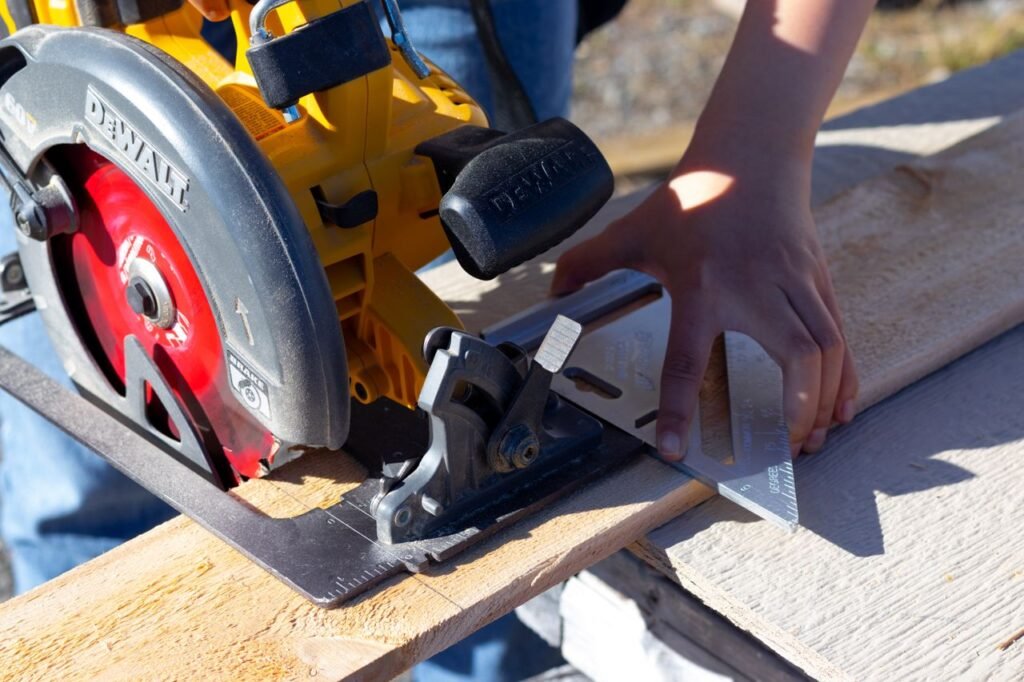
Best Circular Saws of 2026
Compare our top circular saws for plywood, lumber, construction, and fast, accurate straight cuts.

Angle Grinders
Compare our top angle grinders for metal cutting, grinding, masonry work, surface preparation, and demanding DIY projects.