
This cordless tool battery guide starts with compatibility, then capacity, size and your workload. A larger Ah number is not a promise of a particular runtime or a guarantee that the pack will work with your tool.
Check the exact battery platform
Record the tool model, battery model and charger model. Confirm the combination in the manufacturer’s current documentation. A matching brand, connector shape or voltage does not establish approval.
For example, Bosch states that its Professional GBA 18V 5.0Ah pack supports the Bosch Professional 18V System and AMPShare. That specific system statement should not be extended to every Bosch-branded tool.
Use an adapter only within its manufacturer’s stated compatibility and instructions. Physical fit alone does not verify charging, protection or safe operation.
What do Ah and Wh mean?
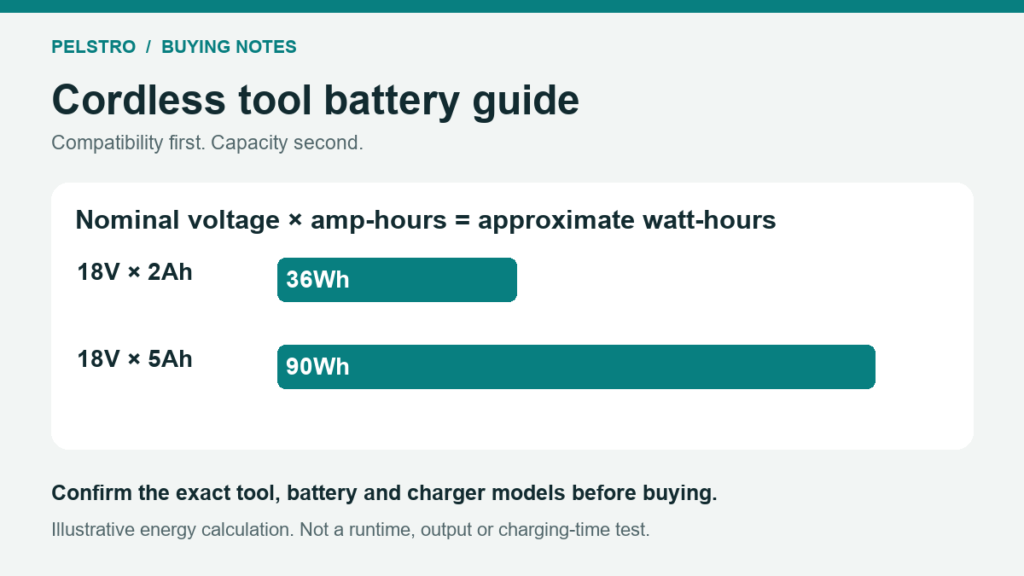
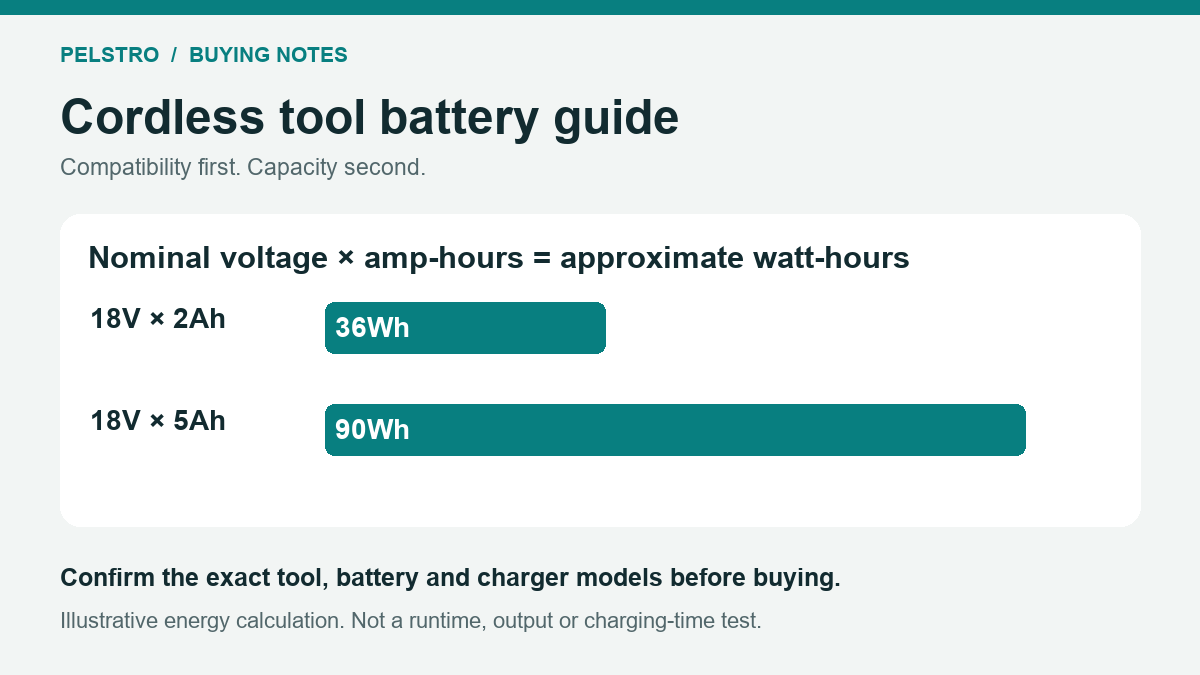
Amp-hours (Ah) describe charge capacity. Watt-hours (Wh) describe energy. A useful label calculation is nominal voltage × Ah = approximate Wh.
| Nominal voltage | Capacity | Calculated energy |
|---|---|---|
| 18V | 2Ah | 36Wh |
| 18V | 5Ah | 90Wh |
This compares nominal stored energy. It does not show usable runtime, tool output or charging time. When a pack has multiple operating voltages, use its manufacturer’s stated energy and capacity definitions.
Does 5Ah last twice as long as 2.5Ah?
Those labels represent twice the charge capacity at the same nominal voltage. Real work also depends on battery construction and condition, load, temperature and the tool’s controls. Do not use the ratio as a guaranteed number of holes or minutes.
Why does DeWalt say 20V MAX?
DeWalt defines 20V MAX as maximum initial voltage measured without a workload; nominal voltage is 18V. See its official battery footnote. Compare equivalent voltage definitions before interpreting labels as a performance advantage. The definition does not make different brands interchangeable.
Choose capacity for the actual job
| Your priority | What to check |
|---|---|
| Light, occasional fastening | Approved compact packs and total working weight |
| Longer or demanding tasks | Recommended pack types, capacity and application guidance |
| Work with few interruptions | Suitable spare packs and documented charging time |
| Adding another tool | Compatibility across the exact tools, not just one brand |
More capacity can come with more bulk and weight, but dimensions vary. Compare the specific packs rather than assuming every high-capacity battery has the same size.
Check the charger as carefully as the battery
Use an approved charger for the battery model. Confirm input voltage, frequency and plug for your country; a travel plug does not change the required electrical supply. Charger compatibility and charge times belong in the manual, not guesses from the tool’s voltage label.
Read the battery instructions for temperature and storage limits. Stop using a damaged pack and follow manufacturer guidance. Our maintenance guide covers routine care.
Use this cordless tool battery guide when comparing kits
Build a simple comparison sheet with one row per offer. Record the tool model, battery model, Ah rating, stated Wh where available, charger model and total delivered price. Leave an unknown field blank and check the manufacturer’s documentation before treating the offer as equivalent to another kit.
Consider two different needs. For occasional work, a suitable pack you already own may make a tool-only purchase sensible. For longer sessions, compare the cost of an approved spare pack with a bundle that includes one. Neither example determines the correct capacity for every tool; the tool’s documented requirements come first.
The purpose of a cordless tool battery guide is to help you ask better buying questions. Ask whether the pack is approved for this exact tool, whether the included charger supports it, and whether the complete working setup suits your space and workload. Capacity arithmetic cannot answer those questions by itself.
Cordless tool battery guide: five checks for a better purchase
- Tool approval: match the full tool and battery model to the manufacturer’s compatibility statement. If it is unclear, confirm it with manufacturer support.
- Capacity definition: compare Ah at the same nominal voltage, or stated Wh where available. A marketing maximum-voltage label is not the same definition.
- Working size: compare the specific pack’s dimensions and weight with your intended space. Include the pack when checking the complete tool setup.
- Charging plan: check approved chargers, documented charging times and regional electrical input. Decide whether you need a spare pack, rather than assuming one larger pack solves every interruption.
- Complete cost: compare a suitable pack and charger separately against the exact kit. Avoid paying for components you already own or cannot use.
More Ah is not a complete performance specification
Capacity, output and charging time answer different questions. A capacity label alone does not identify the pack construction, recommended applications or charge rate. When two packs share an Ah rating, read their individual product guidance before treating them as interchangeable for demanding tools.
One pack or two smaller packs?
Compare approved options for the same platform and tool. A spare may allow you to swap packs, but uninterrupted work depends on actual consumption, charging time and the charging conditions in the manual. Two packs do not guarantee that one will finish charging before the other runs down.
Our cordless tool battery guide uses Wh arithmetic to explain stored energy, not to promise a shift length. For a purchase where runtime is critical, look for tests that identify the tool, task, pack and conditions, or manufacturer guidance for that application. Use the complete-cost worksheet alongside those requirements.
Before buying
- Confirm all three model numbers: tool, pack and charger.
- Compare capacity and total working size against the task.
- Check kit contents and the full local price.
- Read applicable warranty and battery-care instructions.
Use our bare-tool versus kit guide to calculate the complete EUR budget. For tools, see cordless drills, impact drivers and the DCF850 versus DCF860 comparison.
Research-based editorial guidance; no Pelstro runtime testing. Manufacturer references checked 9 October 2026. Further reading: Bosch battery selection guidance and DeWalt battery and charger instructions.